 |
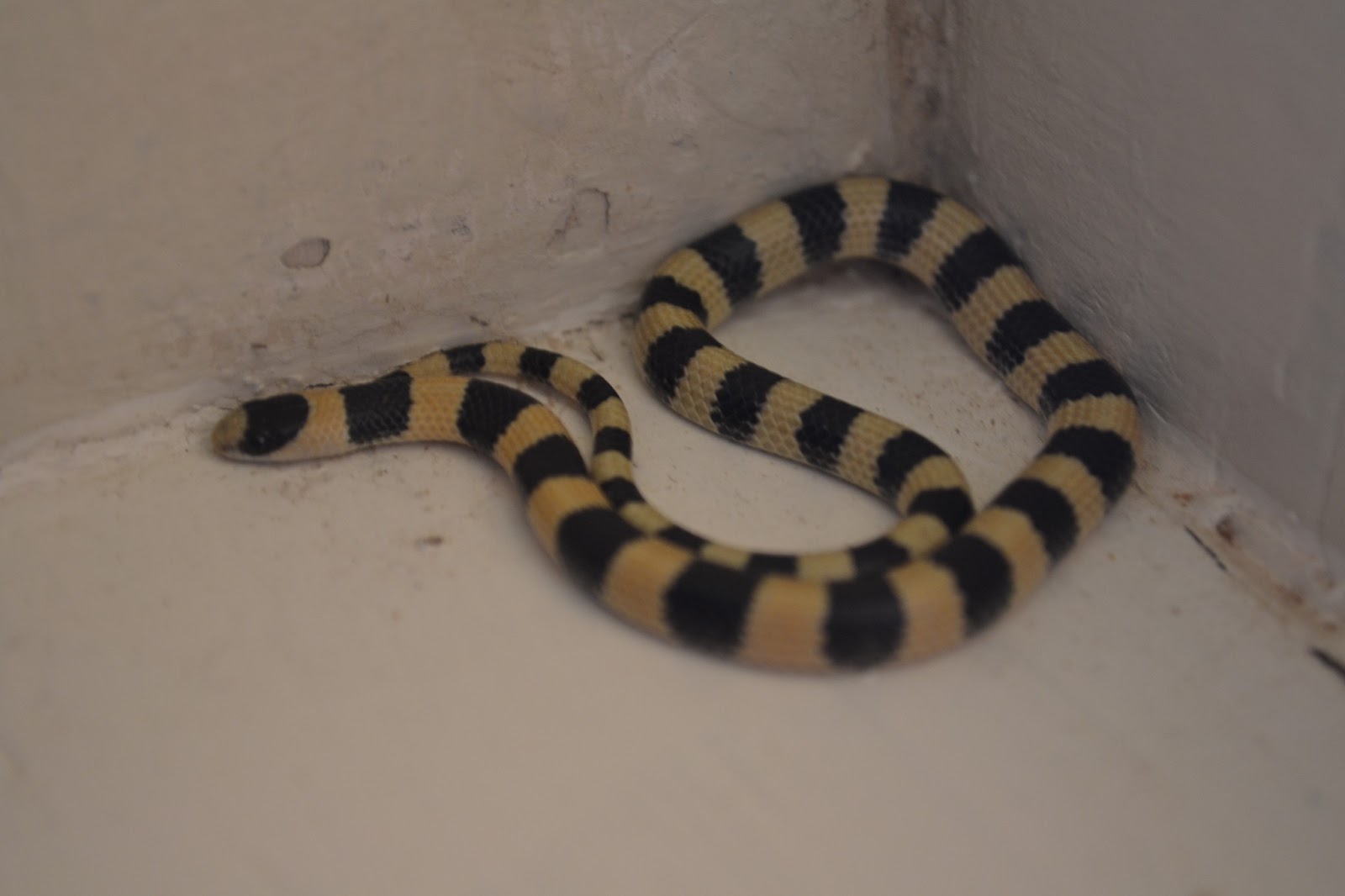
| Sonora semiannulata is immune to scorpion venom. |
Monday, July 22, 2013
Year of the Snake - No. 20 Ground snake
My sister Clara caught this snake in early June while I was at camp in Phoenix. She was swimming in the creek and this snake came swimming by. The easiest catch ever. It was about 5 inches long, probably a juvenile. We released it back at the creek a week later. These snakes are mildly venomous and eat mostly invertebrates including scorpions.

Thursday, June 27, 2013
Year of the Snake - No. 19 Diamondback Rattlesnake
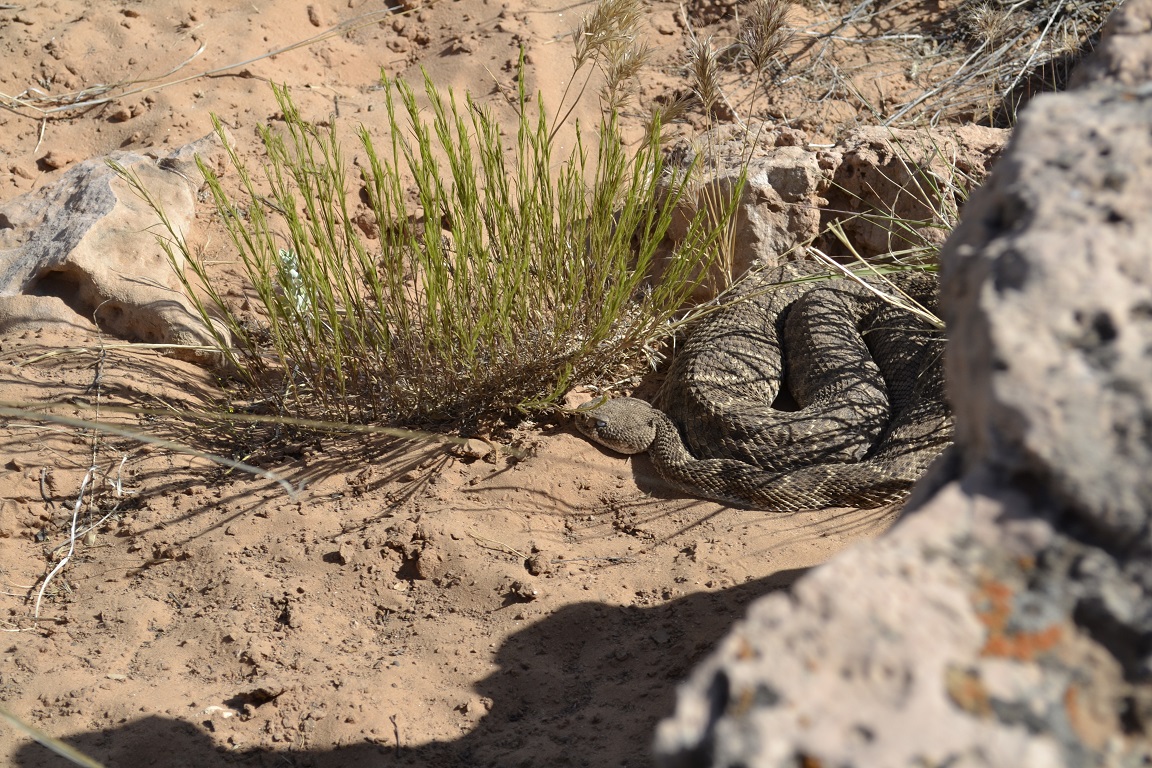 |
| On my second visit, I found this Diamondback Rattlesnake coiled and basking in the sun. I could still see the bulge from his cottontail dinner. |
At the end of May, my
dad came across this Diamondback one evening while walking down the wash. (The
rest of us were in Flagstaff.) The snake was stretched out across the
wash. It had just struck a cottontail rabbit, which was lying motionless.
 |
| Crotalus atrox disappears under a rock. |
Back home a couple days
later, I decided to take a walk, break in my new camera and try to find that
snake. I went to the place my dad said the snake was. I found him coiled up
under an overhanging rock. I visited him a few times over the next couple days
until he moved on.
The Diamondbacks I have
found do not seem as tied to a location as the Arizona Black rattlesnakes. I
can usually go back and see them two or three times, but they eventually move
on.
Wednesday, June 26, 2013
Year of the Snake - No. 11,12,13,14,15, 16, 17, 18 Arizona Black Rattlesnakes
 |
| Crotalus cerberus (yes, like the three-headed dog of Greek mythology) |
What's also interesting is that their color changes from day to night sometimes. Individual snakes can have very different personalities. One snake would sit for hours with me watching. Another time I was walking down a creek bed and one buzzed before I got within 10 feet.
 |
| During the hottest part of the day, the snakes hide in cracks between rocks to stay cool. |

 |
| A pregnant female keeps her body temperature warm by basking on the rocks. |
 |
| This male snake rattled when I was 6 feet away and hadn't seen him yet. He was coiled up under some grass. I only saw the tip of his rattle and thought he might be a juvenile. But when I pushed the grass aside with my snake hook, I found he was an almost 3-foot long adult male (large for this species). He didn't stop rattling and struck at me twice in the 10 minutes I was photographing him. By the way, I was well out of strike range. I think it was a bluff strike. |

Wednesday, June 12, 2013
Lizards of Note: Spiny Lizard, Fence Lizard, and Whiptail.
 |
| Sceloporus magister shows how he got his name. |
These are common lizards here. Sometimes their heads are red and the males can have very blue throats. We found one recently that had a throat and stomach almost entirely blue.
A few weeks after I found a baby Spiny in an metal trash can outside our house.
 |
| Baby Spiny |
 |
| Sceloporus tristichus |
I found this Plateau Fence Lizard under some bricks near our house. These are very common around here and I see them almost daily on the trees. They are closely related to the Spiny Lizard, but much smaller. They both have spiny scales.
Fence lizards of various species are found as far east as Tennessee.
 |
| Aspidoscelis uniparens |
This lizard was first spotted in mom's bedroom. We spied it a couple different places after that and finally caught it in our dining room. This is a Desert Grassland Whiptail. They are very common here. But this is the first I have caught because they are so fast.
These are an interesting lizard because they have one gender -- female. (Note the Latin name uniparens.) They fertilize their own eggs and all are clones of the mother.
Sunday, June 9, 2013
Year of the Snake - No. 10 Western Patch-nosed Snake
 |
| Salvadora hexalepis |
We kept him for a week and then released him near our house.
These snakes have a patch on their nose for digging up the dirt to get at reptile eggs, which are part of their diet.
Sunday, June 2, 2013
Year of the Snake - No. 9 California Kingsnake
 |
| Lampropeltis getula looks very nice against our 1950s carpet. He has been released back to the wild. |
His scales had quite a lot of damage, so he has probably been through a lot. I think he was hunting when I found him. He was moving along, putting his head in and out of holes.
Tuesday, May 14, 2013
Year of the Snake - No. 8 Gopher Snake (Young)
 |
| Pituophis catenifer |
Although he was mellow when I first caught him, he sometimes acts aggressively. He coils and strikes, vibrates his tail, opens his mouth wide to try to intimidate. These are supposed to be very common, but I have not found that many.

Subscribe to:
Posts (Atom)